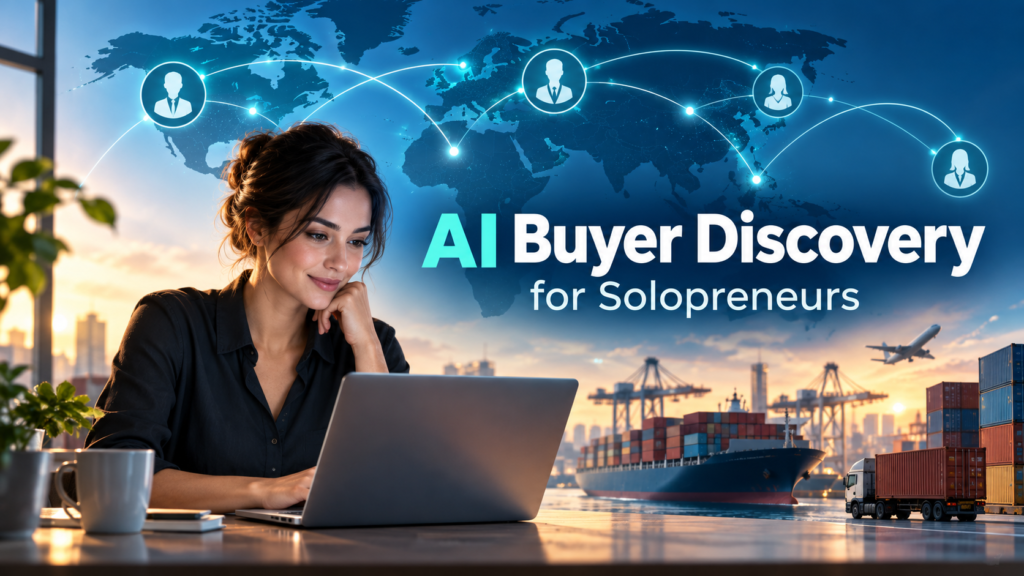
AI Buyer Discovery for Solopreneurs is changing how one-person businesses find international wholesale clients.
Until recently, building a global B2B pipeline often meant expensive trade shows, overseas travel, distributor introductions, and hours of manual research through business directories.
That barrier is becoming much lower.
A solo business owner can now combine trade databases, AI research tools, email verification services, and automated outreach platforms to identify potential buyers and organize prospecting at a scale that previously required a small export sales team.
But there is an important reality to understand.
AI can dramatically improve buyer discovery and lead qualification, but it does not automatically create purchase orders.
The advantage comes from using automation for repetitive research while keeping human judgment in pricing, negotiation, compliance, and relationship building.
1. Manual Buyer Research vs. AI Buyer Discovery
Traditional international prospecting relies heavily on static directories, search engines, LinkedIn searches, exhibitions, and manually collected contact information.
An AI-assisted workflow works differently.
Instead of researching every company one by one, the seller defines the characteristics of an ideal buyer and lets software filter large amounts of information before human review.
| Workflow Step | Traditional Prospecting | AI-Assisted Buyer Discovery |
|---|---|---|
| Buyer Research | Manual directory and web searches | Automated company and trade-data filtering |
| Lead Volume | Limited by available research time | Hundreds of companies can be screened |
| Contact Verification | Often checked manually | Email and domain verification tools |
| Buyer Context | Basic company information | Trade history, company size, product category and public data |
| Personalization | Generic sales templates | AI-assisted personalized drafts |
| Follow-Up | Manual reminders | Automated multi-step sequences |
| Final Negotiation | Human salesperson | Human seller still recommended |
The biggest difference is not simply sending more emails.
It is reducing the amount of time spent researching companies that were unlikely to become customers in the first place.
For a one-person business, that difference can be significant.
2. The Three Pillars of AI Buyer Discovery for Solopreneurs
A practical AI Buyer Discovery for Solopreneurs workflow can be divided into three stages.
Stage 1: Define Your Ideal Customer Profile
Before using AI, define exactly what kind of buyer you want.
Without this step, automation simply produces a larger list of low-quality leads.
Useful filters may include:
- HS codes related to your products
- Target countries
- Import frequency
- Estimated shipment volume
- Company size
- Retailer, wholesaler, distributor, or manufacturer
- Procurement responsibilities
- Existing supplier countries
- Product categories already imported
For example, a Korean skincare exporter should not simply search for:
“Beauty companies in the United States.”
A stronger target could be:
“US distributors importing Korean facial skincare products under relevant HS codes with recurring import activity and established wholesale channels.”
The narrower definition gives AI and trade-data tools a much better starting point.
3. Start With Trade Data, Not Just Google Searches
One of the most useful changes in international prospecting is the ability to combine AI with import and export records.
Trade databases can help identify companies that have already imported products similar to yours.
That matters because there is a major difference between:
a company that might buy your product
and
a company that has already imported the same category.
Historical shipment information may reveal:
- Importer names
- Exporter names
- Product descriptions
- HS classifications
- Shipment frequency
- Origin countries
- Destination ports
- Approximate shipment volume
AI can then help organize this information and rank companies according to your Ideal Customer Profile.
Instead of asking:
“Who sells kitchenware in Europe?”
you can investigate:
“Which European companies repeatedly import stainless-steel kitchen products from Asian suppliers?”
That is a much stronger commercial signal.
4. Find the Person Who Can Actually Buy
Finding the company is only half of buyer discovery.
You also need the right person.
Typical roles may include:
- Procurement Manager
- Purchasing Manager
- Sourcing Manager
- Category Manager
- Head of Procurement
- Supply Chain Director
- Merchandise Manager
- Founder or CEO for smaller companies
Generic company addresses such as:
info@company.com
or
sales@company.com
may still be useful in some situations, but direct communication with an appropriate decision-maker usually provides better context.
AI research tools can help match company information with publicly available professional information before outreach begins.
The goal is not simply to create the biggest contact database.
The goal is to build a smaller list of relevant companies and relevant people.
5. Verify Emails Before Sending Outreach
Automated prospecting creates another problem.
Bad email data can quickly damage sender reputation.
Before running outbound campaigns, email verification tools can check signals such as:
- Domain validity
- MX records
- Mail server availability
- Possible invalid addresses
- Catch-all domains
- Disposable addresses
Your sending infrastructure should also be configured correctly.
Important settings include:
- SPF
- DKIM
- DMARC
- Proper sending-domain configuration
Avoid immediately sending large volumes of cold outreach from the primary domain used for important customer communication.
If deliverability deteriorates, even normal messages to existing customers can become harder to deliver.
AI increases sending capacity.
That makes email discipline more important, not less important.
6. Use AI for Research-Based Personalization
Generic personalization is becoming less effective.
An email beginning with:
“I visited your website and was impressed with your company”
does not demonstrate meaningful research.
A stronger workflow allows AI to analyze available information about the prospect before preparing a draft.
Relevant signals might include:
- Products currently distributed
- Recent product launches
- Existing supplier countries
- Import history
- Store expansion
- New markets
- Recent company announcements
- Product categories missing from the current assortment
AI can turn those signals into the first version of an outreach email.
For example:
Instead of:
“We are a Korean supplier and would like to introduce our products.”
A more relevant message might explain that the distributor already carries products in the same category and describe where your product could complement its existing lineup.
The difference is simple.
One email asks the buyer to understand your business.
The other demonstrates that you already understand part of theirs.
7. Build a Multi-Touch Outreach Workflow
One email is rarely the entire sales process.
A structured sequence may look like this:
Day 1 — Initial Introduction
Explain who you are, why the company was selected, and the commercial reason for contacting them.
Day 4 — Product Relevance
Provide one specific reason your product could fit their assortment.
Day 8 — Evidence
Share relevant specifications, certifications, sales performance, customer data, or distribution results.
Day 14 — Simple Follow-Up
Ask whether the category is currently being reviewed or whether another person handles sourcing.
AI can prepare and organize these messages.
However, automation should stop or change once a buyer starts showing genuine interest.
8. Know When to Turn Automation Off
This is one of the most important parts of AI Buyer Discovery for Solopreneurs.
AI is highly useful during:
- Market research
- Company discovery
- Buyer classification
- Contact enrichment
- Email verification
- Draft preparation
- Follow-up scheduling
- Lead scoring
Human involvement becomes increasingly important during:
- Custom quotations
- MOQ negotiations
- Product samples
- Payment terms
- Exclusive distribution discussions
- Product certification
- Shipping terms
- Contract negotiations
- Video meetings
A buyer asking for a customized quotation should not receive a completely autonomous response based on assumptions.
At that point, the relationship becomes more valuable than the automation.
9. A Practical Solo Export Workflow
A one-person seller does not need to automate everything at once.
A practical workflow could look like this:
| Step | Task | AI / Automation Role | Human Role |
|---|---|---|---|
| 1 | Select target market | Research assistance | Final market selection |
| 2 | Define ICP | Analyze buyer characteristics | Decide buyer criteria |
| 3 | Search trade data | Filter and classify importers | Review high-value targets |
| 4 | Find decision-makers | Enrichment assistance | Confirm relevance |
| 5 | Verify contact data | Automated verification | Remove questionable leads |
| 6 | Research buyer | Summarize public information | Decide sales angle |
| 7 | Draft outreach | Generate personalized drafts | Approve final message |
| 8 | Follow up | Schedule sequences | Respond to genuine interest |
| 9 | Negotiate | Prepare documents and comparisons | Handle commercial decisions |
This is where automation becomes especially valuable for solopreneurs.
You are not replacing the salesperson.
You are removing the repetitive research work surrounding the salesperson.
And in a one-person business, that salesperson is you.
10. The Most Expensive Mistakes to Avoid
Sending Too Much Too Quickly
Automation makes volume easy.
That does not mean maximum volume is the best strategy.
A list of 100 carefully selected importers can be more valuable than 10,000 loosely matched email addresses.
Depending Completely on AI-Generated Buyer Data
AI-generated company information can be incomplete, outdated, or incorrect.
Important buyer information should be verified against reliable databases, company websites, trade records, or other primary sources before outreach.
Ignoring International Email Regulations
International cold outreach is subject to different legal and privacy requirements depending on the destination.
EU GDPR, US CAN-SPAM requirements, and local electronic marketing rules should be reviewed before scaling campaigns.
Provide clear sender identification and a simple way for recipients to stop future communication.
Automating Negotiations
Prospecting and negotiation are different tasks.
AI can help discover the buyer.
It should not independently decide your:
- Wholesale price
- Payment conditions
- MOQ
- Exclusivity
- Credit terms
- Distribution rights
Those decisions directly affect business risk.
11. Why This Matters More for Solopreneurs
Large exporters solve sales problems by adding people.
A solo business usually cannot.
If researching 100 potential buyers requires dozens of hours, the founder loses time that could have been spent on:
- Product sourcing
- Existing customers
- Content marketing
- Marketplace management
- Logistics
- Pricing
- Product development
AI changes the economics of the research stage.
Instead of hiring someone simply to collect and organize information, the solopreneur can use AI to reduce the research workload and focus personal attention on prospects that show real potential.
That is the real value of AI Buyer Discovery for Solopreneurs.
It is not about replacing international sales expertise.
It is about giving a one-person company the research capacity that once required several employees.
Frequently Asked Questions
Does AI Buyer Discovery for Solopreneurs work for physical product exports?
Yes.
It can be particularly useful for physical products because HS codes, import records, distributor information, and shipment histories can provide stronger commercial signals than ordinary web searches alone.
Categories such as beauty, food, home goods, electronics accessories, industrial components, and consumer products may benefit from this approach.
Do I need coding skills?
Not necessarily.
Many modern prospecting workflows can be assembled using:
- AI research platforms
- Trade databases
- Email verification services
- CRM systems
- No-code automation platforms
- Spreadsheet tools
- Email sequencing platforms
More advanced systems can use APIs, but a useful workflow does not have to start there.
Can AI automatically find customers and close deals?
It can help find and prioritize potential customers.
Closing the deal is different.
Product quality, pricing, certification, logistics, payment terms, communication, and trust still determine whether a prospect becomes a real customer.
How quickly can I expect results?
There is no universal timeline.
Results depend heavily on:
- Product competitiveness
- Target market
- Buyer quality
- Pricing
- Email deliverability
- Brand credibility
- Outreach quality
- Follow-up consistency
Instead of expecting immediate purchase orders, measure early progress through reply rates, qualified conversations, sample requests, quotation requests, and buyer meetings.
Final Takeaway
AI Buyer Discovery for Solopreneurs gives one-person businesses a new way to approach international B2B sales.
The winning strategy is not to automate every part of exporting.
It is to automate the parts machines handle well:
data collection, filtering, verification, research, organization, and initial drafting.
Then use human judgment where it matters most:
trust, pricing, negotiation, and long-term relationships.
For a solopreneur, that combination can turn international prospecting from an exhausting manual search process into a repeatable sales system.
The technology does not eliminate the need for sales skills.
It simply allows one person to spend far more time selling—and far less time searching.