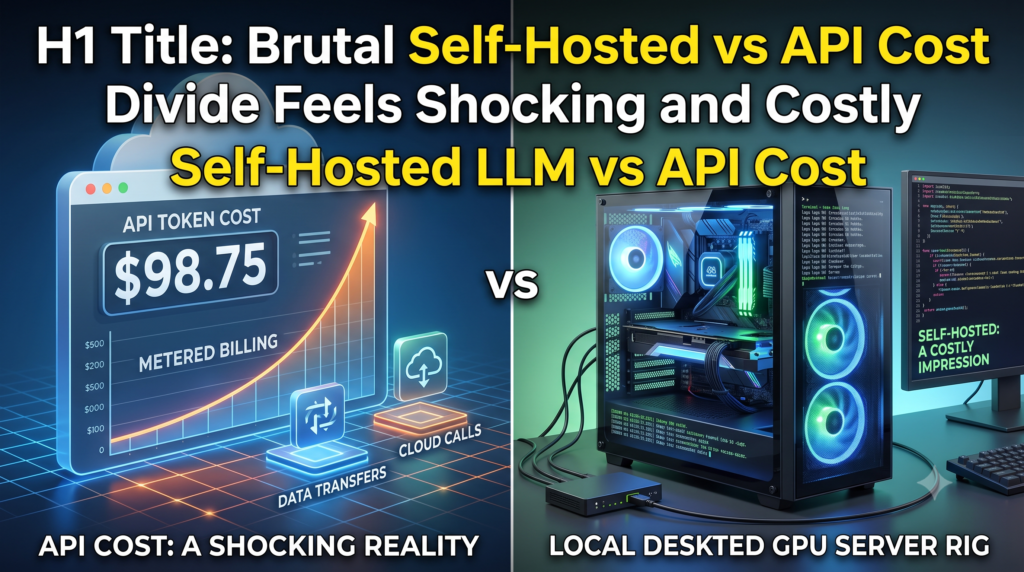
Is self-hosting an open-weight LLM actually cheaper than paying for an API? For most solopreneurs, the API remains cheaper until usage is both high and consistent. A dedicated GPU can look inexpensive on an hourly price sheet, but idle capacity, engineering time, reliability, and model maintenance can move the real break-even point far beyond the first estimate.
This guide compares API endpoints, rented GPUs, and owned hardware using transparent assumptions. The figures below are illustrative, not universal. Recalculate them with your model, input-output token mix, throughput, provider, and utilization before making an infrastructure decision.
Quick answer: Use an API for variable or early-stage traffic. Consider self-hosting when you can keep the hardware productively busy, need tighter control over data or model weights, or have an offline workload that an external endpoint cannot serve.
The Three Cost Models You Are Really Comparing
A useful self-hosted LLM vs API cost comparison separates three different operating models:
- Serverless API: You pay for input and output tokens. Providers handle scaling, redundancy, drivers, and model serving. Services such as Together AI publish per-model token pricing, and the bill can fall close to zero when there is no traffic.
- Rented dedicated GPU: You pay for the instance while it is running, whether it is processing tokens or waiting. Current RunPod pricing varies by GPU, cloud tier, and availability. Storage and network charges may be separate.
- Owned workstation: You pay upfront for the GPU, CPU, memory, storage, power supply, cooling, and replacement risk. The purchase price should be amortized across the period in which the machine will realistically be useful.
Do not treat a GPU’s maximum board power as its idle draw. An RTX 4090 is commonly described as a roughly 450-watt card under heavy load, while idle consumption is much lower and varies by system, displays, power settings, and software. Electricity calculations should use measured wall power for your own workload.
For a separate comparison of owned desktop hardware, see our guide to the real cost of local AI on a Mac mini or mini PC.
How to Calculate the Break-Even Point
Start by calculating a blended API price. If input and output tokens have different prices, weight each price by your actual traffic mix.
Blended API price per token = (input share × input price) + (output share × output price)
Then compare that amount with the full monthly cost of self-hosting:
Break-even monthly tokens = (fixed monthly infrastructure + amortized setup cost + monthly operations labor) ÷ (blended API price per token – self-host variable cost per token)
The denominator must remain positive. If your self-hosted variable cost per token is equal to or higher than the API price, additional volume will not create a cost advantage.
Worked Example
Assume a small model costs $320 per month to keep available. The comparable API averages $0.10 per million tokens, and electricity plus other variable self-hosting costs equal $0.01 per million tokens.
- Net API savings from self-hosting: $0.09 per million tokens
- Monthly break-even: $320 ÷ $0.09 = about 3.56 billion tokens
- Daily average: about 119 million tokens per day
This calculation still needs a throughput check. A theoretical cost break-even is meaningless if the selected GPU cannot deliver the required tokens per second at the desired context length, latency, and concurrency.
Illustrative Model-Tier Comparison
The table uses broad price ranges to show how sensitive the answer is to assumptions. The break-even figures use a simple fixed-cost divided by API-price calculation before adding labor and other variable costs.
| Model tier | Illustrative API rate per 1M tokens | Illustrative monthly infrastructure | Simple daily break-even | Likely choice |
|---|---|---|---|---|
| 8B class Llama 3.1 8B, similar small models |
$0.06 to $0.15 | $245 to $535 Single 24GB GPU, always on |
About 54M to 297M tokens/day | API for most variable workloads |
| 70B class Llama 3.3 70B, Qwen 2.5 72B |
$0.40 to $0.70 | $1,800 to $2,400 Illustrative high-memory deployment |
About 86M to 200M tokens/day | Hybrid or dedicated hosting at sustained volume |
| Frontier open-weight class DeepSeek-V3 or Llama 3.1 405B |
$2.00 to $8.00 | $14,000 or more Multi-GPU cluster |
About 58M to 233M+ tokens/day | Managed API for most solopreneurs |
Important: DeepSeek-V3 is a mixture-of-experts model with 671 billion total parameters and 37 billion activated per token. Llama 3.1 405B is a separate dense model. They should not be described as the same 405B MoE architecture. See the DeepSeek-V3 technical report for the model architecture.
Five Costs That Common Break-Even Estimates Miss
- Low utilization: A GPU that is reserved for production but busy only a few hours per day has a high effective cost per token.
- Throughput and concurrency: Context length, quantization, batching, and simultaneous users can reduce the token rate that looked achievable in a single-user benchmark.
- Reliability: Production service may require monitoring, restarts, backups, spare capacity, and failover. One GPU is also one failure domain.
- Engineering time: Driver changes, container updates, serving frameworks, observability, security patches, and model migrations consume founder time. Assign that time a realistic hourly value.
- API discounts: Some vendors offer cached-input or batch-processing discounts. Together AI, for example, documents batch discounts for supported workloads. Compare the discounted API bill you can actually obtain, not only the headline rate.
When Self-Hosting Makes Sense for a Solopreneur
Self-hosting can be strategically correct even when it is not the cheapest option on a per-token spreadsheet.
- Stable, high utilization: You have measured traffic and can keep the hardware busy for a substantial portion of the day.
- Custom weights and serving stack: You need a specific quantization, LoRA adapter, decoding method, or model version that a managed provider does not offer.
- Offline or edge operation: The product must continue working without reliable internet access.
- Data-control requirements: Contracts, customer expectations, residency rules, or internal policy require greater control over where prompts and outputs are processed.
- Predictable latency: A dedicated deployment may provide steadier latency when the workload and capacity plan are well understood.
Privacy regulations do not automatically prohibit all cloud processing. For example, HIPAA-covered organizations may use a cloud service provider when the required safeguards and agreements, including an appropriate business associate agreement, are in place. Evaluate the exact provider, contract, region, retention policy, and applicable law rather than assuming that self-hosting is mandatory.
A Practical Decision Checklist
Before purchasing hardware or reserving a dedicated instance, collect at least two weeks of production or pilot data and answer these questions:
- How many input and output tokens do we process each day?
- What are the average and peak requests per minute?
- Which exact model and quantization meet our quality target?
- What throughput does that configuration achieve at our context length?
- Can the GPU be shut down during idle periods?
- What is the monthly value of setup, maintenance, monitoring, and incident response time?
- Does the API provider offer caching, batch pricing, committed-use discounts, or data-retention controls?
- What happens when traffic doubles or the selected hardware fails?
If these answers are not yet measurable, use an API first. Instrument token usage and latency, then revisit self-hosting after the workload becomes predictable.
Frequently Asked Questions
What is the fastest way to estimate my break-even point?
Add the complete monthly self-hosting cost, subtract the self-hosted variable cost from the blended API price, and divide. Use separate input and output token prices and include engineering time. Then verify that the hardware can physically process the resulting daily token volume.
Can an Apple Silicon Mac Studio replace a cloud GPU?
A Mac Studio with sufficient unified memory can run quantized large models for personal use, development, and batch processing. It is less straightforward as a multi-user production server because throughput, software compatibility, concurrency, redundancy, and remote operations also matter. Benchmark the exact model and workload before treating it as a production replacement.
Does HIPAA or GDPR always require local inference?
No. The answer depends on the data, legal role, provider terms, contracts, safeguards, processing region, and retention policy. Under HIPAA, a compliant cloud arrangement can be possible with the required business associate agreement and controls. GDPR also requires a lawful and appropriately protected processing arrangement rather than imposing a universal ban on external providers.
Should I compare an open model with a frontier commercial API?
Run both comparisons. First compare the self-hosted model with a hosted API serving the same or a closely equivalent open model. Then compare it with the commercial model that meets your product’s quality target. A cheaper model that cannot perform the task is not a valid substitute.
Sources and Update Notes
- RunPod GPU pricing
- Together AI token pricing
- Together AI serverless billing, caching, and batch documentation
- DeepSeek-V3 technical report
- U.S. HHS guidance on HIPAA and cloud computing
Pricing and model availability change frequently. Verify vendor pricing immediately before making a purchase or infrastructure commitment.